
Change is afoot to futureproof the urban realm, reports Gillian Taylor in her City of London walkabout
Shifting weather patterns due to climate change are impacting private gardens and public areas. As a regular visitor to the City of London, I’ve spotted a move towards permanent planting schemes, away from the historic colourful swathes of bedding plants.
Plant choices and garden design must change to future-proof flora. The principles discussed here use examples of city gardens that demonstrate how resilient planting can be beautiful and practical. Plants should be appropriate for local conditions, and good choices remove the need for compromise on quality. Resilient planting schemes need to be waterwise – designed to reduce or eliminate the requirement for irrigation.
The Value of Gardens report published last year by the Horticultural Trades Association (HTA) emphasised the importance of green spaces in urban areas. Buildings and hard surfaces absorb and retain heat, so often the temperature is much higher in city environments.
Trees and large shrubs can provide significant cooling effects by providing shade and absorbing heat. Trees reduce water runoff issues as their canopies intercept rain, and their roots can absorb large volumes of water.
At London Climate Action Week 2026 the increased provision of trees within city areas was classified as “transformative” positive action that could be taken to help mitigate the impacts of increased heat on health and economic productivity.
Reducing pollution impact
Hedges meanwhile can function as pollution absorbers. Shrubs with dense, waxy or hairy foliage work best and used as low level hedging can significantly reduce local air pollution levels, Royal Horticultural Society (RHS) research reveals. “A 1 m dense hedge can absorb pollution equivalent to that produced by a car on a 500-mile journey,” was the startling conclusion.
Designers and landscapers have a key role to play here. Many are experimenting with new planting schemes and landscaping techniques to mitigate surface water problems in built-up areas.
Rain gardens for example are planted areas that capture and absorb rainwater runoff from roads, driveways and roofs. Low maintenance and more cost effective than other drainage systems, they are an effective tool.
Swales – shallow planted channels helping water infiltration into the soil – are becoming more extensively used in open space settings.
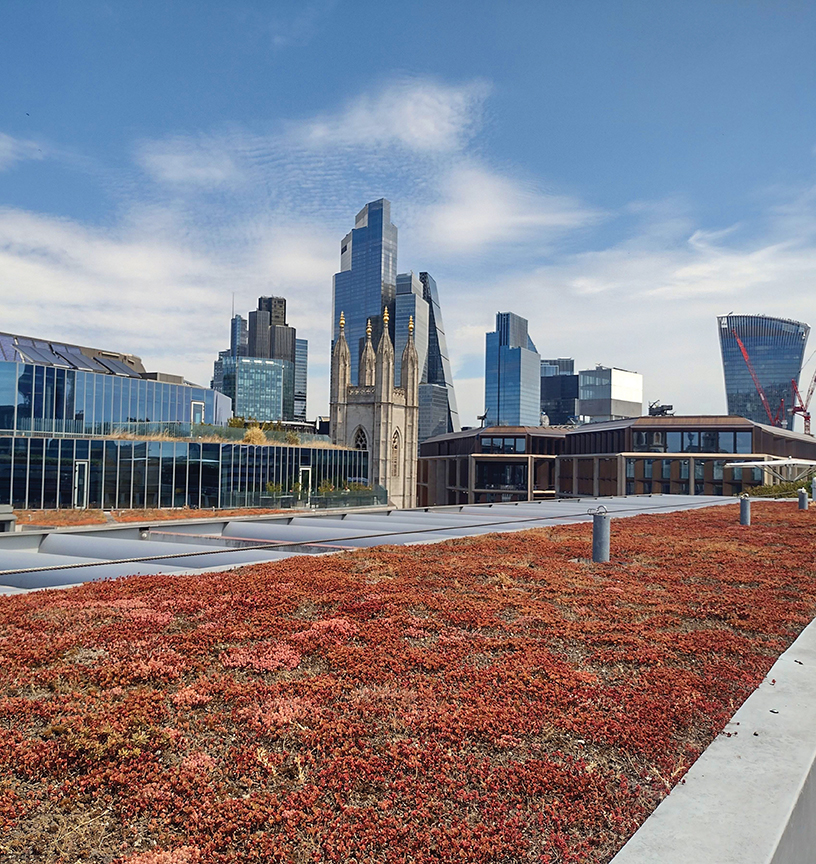
Rainwater should be our number one resource and in many City of London gardens, at street and roof level, rainwater harvesting systems have been installed, while other adaptations include permeable paving , green roofs on sheds and bicycle stores.
Shade is commonplace in urban environments. It can vary between dappled light through tree canopies to high shade caused by tall buildings – so-called urban canyons – through to deep shade where no direct sunlight is present.
Plant suggestions here include Acanthus mollis, Fatsia Japonica, Hostas, Heuchera villosa Autumn Bride, Hydrangea quercifolia and Pachysandra terminalis. A favourite of mine, Bergenia Ciliata Wilton, is also a great performer in these conditions.
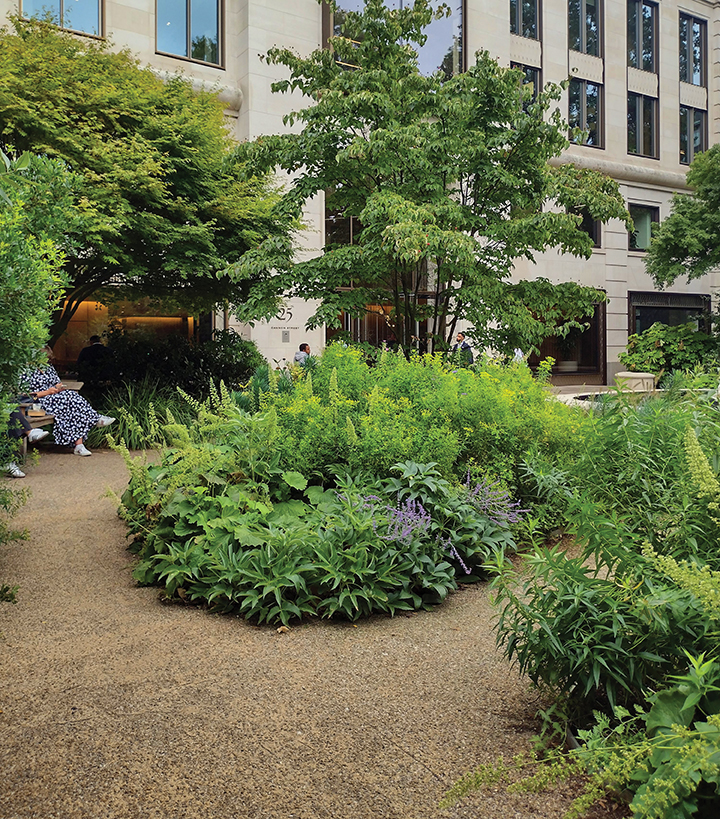
A partly shaded seating area in Cannon Street showed Heuchera Autumn Bride thriving, interspersed with Hellebore and Euphorbia cultivars.
The tall white flower spikes are produced from late July through to December and the evergreen foliage is a pleasing shade of apple green.
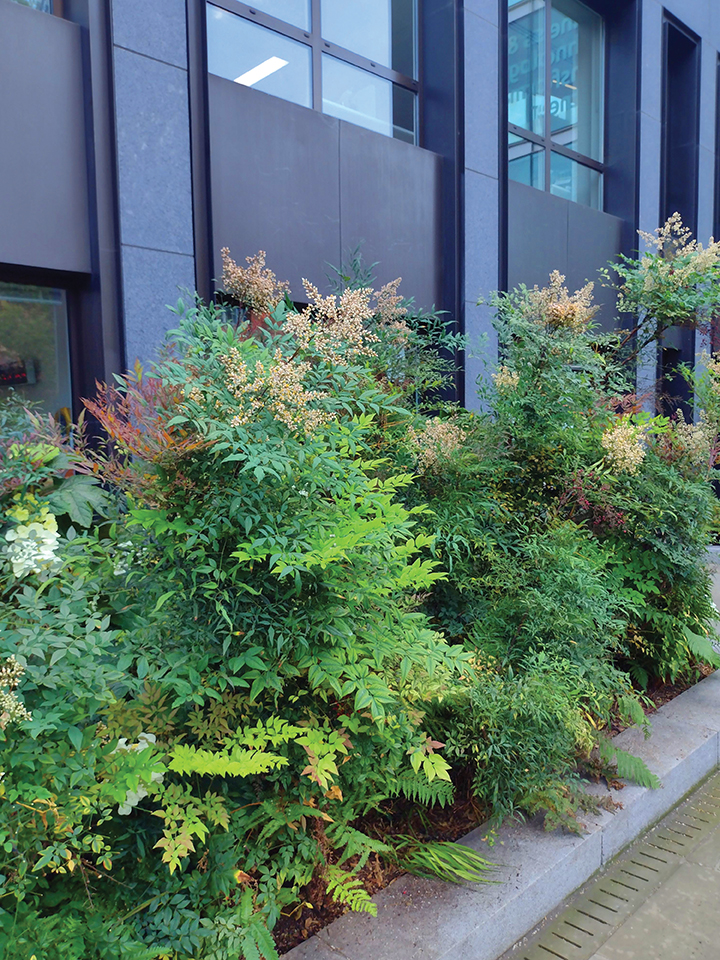
Permanent planting
The increased significance of sustainability within horticultural practice has resulted in a shift towards permanent planting schemes. An excellent example of this is Senator House garden, managed by the City of London Corporation.
Redesigned between 2017 and 2019 it was transformed from a simple grassed area into colourful, multilayered borders full of texture and interest. The height of the planting allows for areas of seclusion and the provision of habitat.
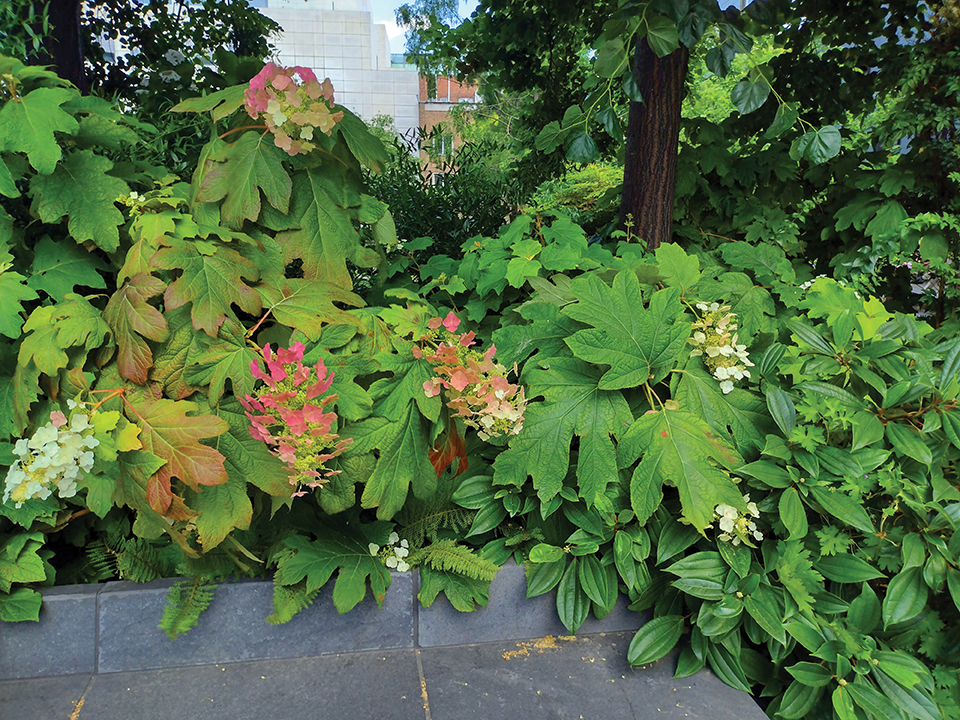
Here, the use of the oak-leaved hydrangea, ferns and Viburnum davidii provide dramatic foliage effects and varied textures. The border is layered from ground cover to small trees, and the plants have similar cultural requirements.
Mulching is practised but is kept low key so as not to be overbearing. The plants soften the hard landscaping edges and enclose the seating area for increased seclusion. Striking effects are achieved using bulbs and corms such as Crocosmia. Nandina domestica provides months of interest with its attractive foliage and flowers, which are followed by impressive seedheads.
The principles for resilient planting in varying garden styles should be considered with the mindset that we are looking to collaborate with nature rather than control it and one that should result in less repetitive work and increased gains for biodiversity.
Many plants have adapted to cope with periods of drought, intense heat or wind, making them ideal for the trickiest situation in the City of London, the roof garden.
Adaptations for drought include waxy coated leaves, hairy leaves, small leaf size, deep roots, aromatic oils, reflective grey or silver foliage. Plants with fine waxy leaves and thin flexible stems cope with blustery conditions: excellent examples being Verbena, Nepeta, Allium and grasses such as Anemanthele lessoniana.
Weight and depth
Roof container planting is a compromise between weight and depth, so most plants in long borders will be shallow rooted. For specimen shrubs, containers often contain a special lightweight growing medium developed for use on roof gardens. Shrubs provide interest, habitat, structure and are often used to create secluded areas.
Pittosporum tobira, Pinus mugo and Choisya x dewitteana
Aztec Pearl have proved reliable in such harsh conditions.
Erigeron karvinskianus is a popular choice for underplanting – tough and low maintenance, this fleabane must surely be the ultimate resilient groundcover.
Salvia ‘Amistad,’ Sedum ‘Red Cauli, Oenothera ‘Sparkle White’ planted with mixed Alliums provide a feast for pollinators. The classic low growing Sedum roof is being superseded by more adventurous planting choices.
In this Cannon Street garden, the planters were covered in a soft grey coating to reduce heat absorption and to complement the planting. The design is a success for all end users – human and insect.
The Tom Stuart Smith Studio-designed garden sets the standard, and when I visited last summer it was alive with insects. A veritable feast for the eyes and the pollinators, it also provides an immersive and enriching experience for the office staff who have access to it.
That the provision of green space in the urban environment is important for people living and working there is widely understood – a chance to relax and refocus. On questioning, members of the public gave varying answers to why they valued these gardens:
“They allow escape from tensions at work, stimulation for the senses, areas of sanctuary and green oases in the concrete jungle,” was a common response.
Fresh vision
The importance of taking climate change action now is highlighted in the report Heat Ready London, which sets out a fresh vision for protecting the capital from extreme heat. A study in preparing the plan revealed that London’s 2022 heatwaves are estimated to have cost the city £1.5 billion, reflecting the combined impact on health, learning, transport, energy use, emergency services, wildfires and lost productivity.
“The priority areas of focus will help Londoners see more trees, greener streets and cooler public spaces,” it stated, “especially in the areas that face the highest risk in hot weather.
“Parks, public realm, buildings and transport routes will have plants that can cope with heat, drought and wildfire, and can provide shape… helping Londoners and nature stay healthy, connected and able to cope.”
As landscapers, architects, garden designers and plant specifiers, we can all help in this vital mission.
https://www.london.gov.uk/programmes-strategies/environment-and-climate-change