
Well worth the extra outlay to foster sustainable planting, finds Peter Burks
I am often asked “Why is the peat-free debate important?” and of course the simple answer is, that peat is great for the planet, if its left in the ground.
There are vast areas of the world covered by peat bogs that have been slowly accumulating for thousands of years. A peat bog is a spongy, waterlogged wetland formed by partially decayed plant matter – primarily Sphagnum moss – building up over millennia in acidic, low-oxygen conditions.
These vital ecosystems act as massive carbon sinks, store vast amounts of fresh water, and support rare wildlife. So its easy to see they are rather precious and should be conserved.
Peat has been dug and dried and used as a fuel for thousands of years too but in times when the world’s population wasn’t so huge this didn’t affect the peat bogs too much. With the advent of container grown plants, a relatively recent development in our industry as it only really began when plants started being grown in tins about 75 years ago, also began the search for good composts to grow in.
Peat was soon acknowledged to be perfect for this. It was acidic, held water and nutrients well, contained no pests, diseases or weed seeds and was relatively stable in terms of its state of decomposition. It started being used in huge quantities worldwide.
Awareness sparks rethink
With more awareness of the destruction of peat bogs and the value of keeping the carbon locked up began a rethink on whether we should be using this for horticulture or not. This is not a new thing as compost manufacturers have been producing peat-free composts for more than 40 years and some have never used peat.
The general population has slowly become more aware of the issues of using peat and compost manufacturers have made great strides in producing high-quality alternatives over the last five years or so.
Latest figures from the Horticultural Trades Association (HTA) show that UK growers and plant producers have continued to make substantial progress in reducing peat use, with peat accounting for just 21.8% of growing media in 2025, down from 34.4% in 2024 and 39.5% in 2023. This equates to professional peat levels falling by more than 60% since 2021, when it stood at 56%.
The findings show that the biggest challenges for growers moving away from peat are nutrient and fertiliser management, costs and profitability, consistency of peat-free growing media and irrigation management.
The HTA says growers reported that fully peat-free growing media could cost around 10% more overall, with individual businesses reporting cost increases of between 5% and 15%, before accounting for expenditure on trials, staff training, production changes and potential crop losses.
Water management
In many cases, growers are redesigning irrigation systems, adapting nutrient programmes and developing entirely new production techniques to maintain plant quality and consistency.
Water management is an increasingly important part of that challenge. Growers are having to learn how different growing media behave and to invest in new approaches to irrigation that deliver both crop quality and resource efficiency.
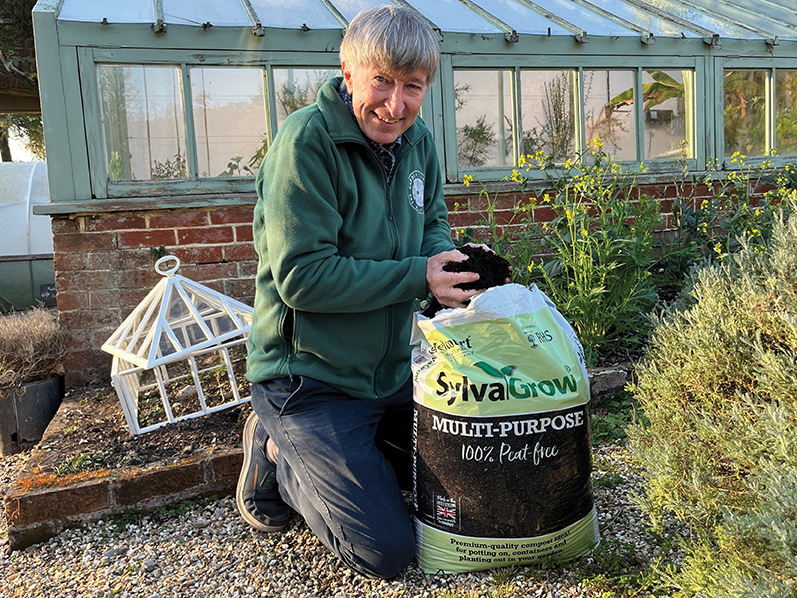
In garden centres there will be a range of composts available and we know that most work well. Those that are 100% peat free will usually say that on the bag so if it doesn’t you can assume there is still some peat content.
The peat-free composts will be made up from various different products such as coir, garden waste, green material such as grass cuttings, which could have been grown on a field scale specifically for use in compost, bark, other wood industry waste, soil and additives such as perlite and vermiculite.
We know these new mixes do work well although they can be variable. I find the most important thing to do to ensure success is to add slow-release feed granules to all composts as soon as you use them. Watering needs to be closely monitored but is not usually a significant problem.
Water management is becoming an increasingly significant issue for many businesses, particularly as growers face hotter summers, prolonged dry periods and mounting pressure on water resources.
Peat-free growing media often require different irrigation approaches and greater monitoring to maintain optimum growing conditions, meaning the transition is often about changing entire production systems rather than simply replacing one growing medium with another.
Complex issue
“The data also reinforces an important point,” David Denny, HTA director of research and knowledge transfer, said recently. “Peat-free growing is not simply a case of swapping one material for another. There is no single, like-for-like alternative that works across the thousands of plant species grown commercially in the UK.”
Hardscaping sales rack up healthy growth
The GCA has enjoyed a busy and positive summer, with strong trading figures and a packed programme planned for members in the months ahead. July’s garden centre members’ sales rose 10.66% compared with the same month last year, despite prolonged heat and water restrictions across much of the UK. Hard landscaping sales recorded healthy growth, as did outdoor plants and furniture.
The GCA is counting down to its 2027 annual conference in Stratford-upon-Avon in January, when the event will feature expert speakers including Sir Jason Kenny CBE, Kate Hardcastle MBE, Justin King CBE and Clive Humby OBE, alongside networking sessions and awards presentations.
Meanwhile, entries for the body’s prestigious Worrall Cup marketing competition opened on 1 September, to a revised deadline of 31 October.
Peter Burks, CEO of the Garden Centre Association, is a fully trained horticulturalist and has worked in directorial and senior management positions for garden centres nationwide for more than 40 years.
He ran garden centres with his parents until they retired. Three other family members also work in the sector.
Peter helped set up then ran the multi award-winning Sanders Garden World in Somerset for more than 10 years, being named GCA Garden Centre of the Year twice in that time.
He was southwest regional manager for Wyevale Garden Centres, before becoming general manager for Trelawney’s in Cornwall, and managing Fermoys Garden Centre in Devon, part of the Blue Diamond group of garden centres.