


A mapping and analysis tool to help local authorities understand how neighbourhoods perform against the 3-30-300 principle – an emerging standard for healthy, nature-rich urban environments – has been launched for the UK by Treeconomics.
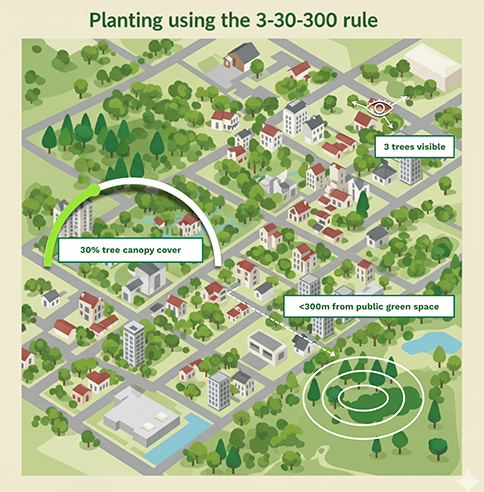
The 3-30-300 rule, proposed by international urban forestry expert Dr Cecil Konijnendijk, sets out three simple targets:
Three trees visible from every home
30% canopy cover in every neighbourhood
300 m maximum distance to the nearest publicly-accessible green space
International attention
“The principle is gaining international attention,” says Treeconomics, “with cities and researchers in Europe, North America and Australia exploring it as a practical framework for improving access to urban nature.”
Although the concept is still relatively new in the UK, it adds, councils here are increasingly seeking practical methods for improving liveability in towns, “with a focus on long-term climate resilience and fair access to nature”.
‘Fair Access’ was further highlighted in 2023 with the release of the UK’s Tree Equity Score map, designed to help address disparities in urban tree distribution*.
Local authorities are tasked with delivering greener neighbourhoods under multiple frameworks, including:
The Environmental Improvement Plan (Defra, 2023)
Local nature recovery strategies
Bio diversity net gain requirements
Local climate action plans as well as local travel and wellbeing initiatives
“However, many councils lack the metrics to evaluate urban tree provision at street-by-street level, where the lived experience exists,” Treeconomics states.
Simple benchmark
“Urban Forest 3-30-300 aims to fill this gap by offering a simple benchmark that complements existing canopy studies, Local Plan evidence bases, and tree strategies.
“It is able to translate the rule into a building-level analysis of how homes, streets and neighbourhoods within a local authority area perform against each element.
Using GIS and Ordnance Survey data, the tool presents:
Streets with limited tree visibility
Neighbourhoods falling short of 30% tree canopy
Areas where residents lack accessible green space within a 300 metre walk
Results are presented on a map, accompanied by an interpretive report which can support planning, policy, and engagement with stakeholders such as councillors, senior officers and community groups.
“The 3-30-300 rule offers a resident-centred way to think about access to nature: can people see trees, and do they live among trees?” said Treeconomics’ John Rose. “Urban Forest 3-30-300 allows UK councils to understand this at multiple levels from individual buildings, to streets and neighbourhoods, right up to the whole town or city. It is an accessible starting point for the effective allocation of resources on the ground.”
Actionable help for councils
Dr Cecil Konijnendijk, Nature Based Solutions Institute, commented: “I am pleased to see UK organisations adopting the 3-30-300 principle. The rule is meant to be practical and actionable, helping cities improve health, wellbeing, biodiversity, and climate resilience. Tools like Urban Forest 3-30-300 make it easier for local authorities to understand where they stand and where targeted greening can have the biggest impact.”
Interest in the 3-30-300 concept has expanded rapidly since its introduction, driven by academic research, international municipal case studies, and rising public recognition of the importance of everyday contact with nature. For UK local authorities, the concept offers a straightforward way to align greening initiatives with broader social, environmental and health priorities.
https://www.treeconomics.co.uk/3-30-300
* In 2023, The Woodland Trust and Centre for Sustainable Healthcare partnered with American Forests, the US non-profit organisation that created Tree Equity Score, to bring Tree Equity Score to the UK