

Despite the challenging conditions posed by the record-breaking summer temperatures and drought, some well-loved species such as the common red oak (Quercus rubra) and Golden Honey Locust (Gleditsia triacanthos ‘Sunburst’) have erupted into a riot of colour around the Gardens.
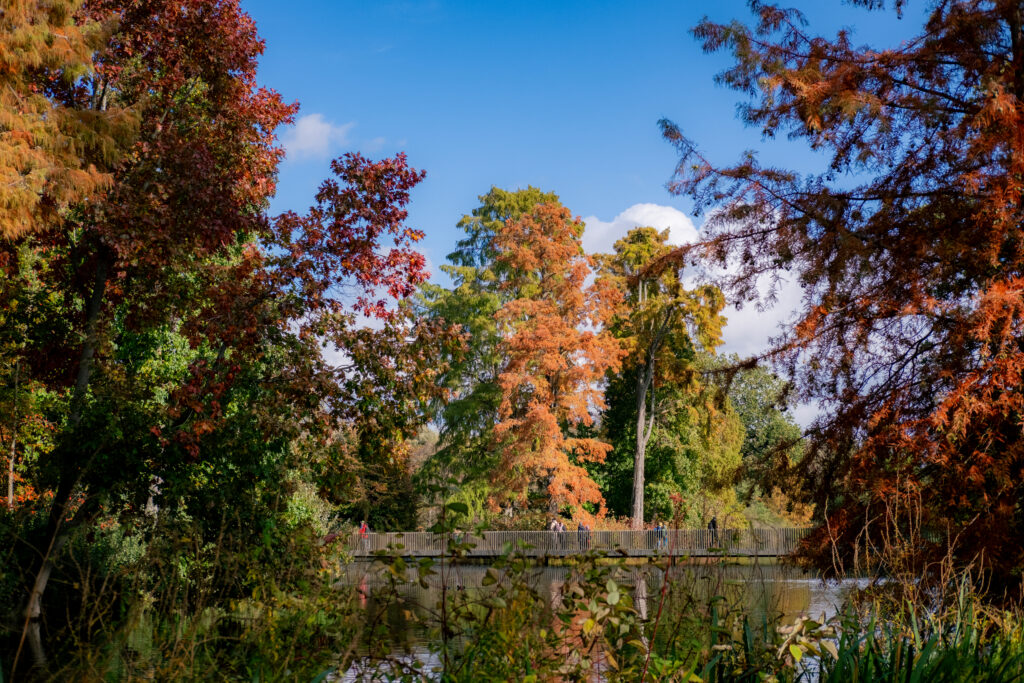
Autumn favourites such as the iconic Maidenhair trees (Ginkgo biloba) have turned the lawns outside Kew’s Orangery into a sea of yellow, and several Japanese maples (Acer palmatum) have turned crimson red.
The Winter Garden has a wonderful display on with the leaves of Cornus sanguinea ‘Anny’s Winter Orange’ and Cornus alba ‘Sibirica’ (Westonbirt Dogwood) taking on an autumn tinge, highlighting their red and orange stems as their leaves drop away. Nearby trees of Acer amoenum var. matsumurae, Acer sieboldianum and sugar maple (Acer saccharum ‘Glaucum’) look equally impressive with hues of yellow and orange.
Nature adapting
And venturing deeper into the Gardens and the Arboretum, stop by the Waterlily Pond to see a lovely combination of purple Cotinus obovatus x goggyria, golden yellow gingkoes and rusty orange golden larches (Pseudolarix amabilis). The leaves of a Swamp cypress (Taxodium distichum) around the pond are turning rusty orange, as are those of a mulberry-leaf maple (Acer morifolium).
Many trees are struggling, however, and have turned over early or lost their canopies entirely because of the intense summer and spring droughts. This phenomenon, known as ‘False Autumn’, has resulted in a mixed landscape across swathes of the UK.
Cutting edge research and horticultural science developed at Kew is helping to identify which of their trees are well adapted to deal with their changing climate, and which tree species should be planted today to give them the best chance of survival well into the future.
Research published by Kew’s experts has shown species such as Farges’ fir (Abies fargesii), Iberian alder (Alnus lusitanica), cherry hackberry (Celtis cerasifera), Montezuma pine (Pinus montezumae) and spoon oak (Quercus urbani) are well adapted for a warmer and drier future.
Future Forests
Many of these trees have been identified in Kew’s 2024 Landscape Succession Plan: Planting for the Future report, which combined novel climate modelling with horticultural research to assess the vulnerability of Kew Gardens’ trees by the year 2090.
Kevin Martin, Head of Tree Collections at Kew, says: ‘At Kew Gardens, their 11,000 trees represent an extraordinary diversity of species from around the world that make the Gardens a living laboratory to understand how trees respond to climate change.
‘We expect autumn to come forth with a spectacular burst of colour, but we can already see that the pressures of our record-breaking summer are altering the timings of when trees change colour, how long their displays last and how well they cope with environmental stress.
‘By studying such a diverse collection of trees in one place, we can better understand which species are most vulnerable, and which have the potential to thrive in the warmer, drier conditions that the UK is likely to experience in the future.’
Autumn Highlights
The hollies (Ilex) on other side of Holly Walk look exceptional right now, with a variety of leaf shapes and bright red berries. Established in 1874, Kew’s collection is one of the most comprehensive and diverse in Europe.
Now is also the perfect time to visit Kew’s iconic glasshouses, which provide a bit of warmth and tropical comfort as the cold starts to set in. Be sure to visit the Princess of Wales Conservatory for your last chance to see the giant Victoria waterlilies before they are removed by the end of the month for the winter.
Inside of the Temperate House, several tea plants (Camellia sinensis) continue to put out flowers in both beds on the southern end, and if you are lucky enough, you might spot a large imperial lemon (Citrus lemon ‘Imperial’) staring back at you from amidst the foliage.
Within the glasshouse’s central block, the main entrance is framed by the pink and cream trumpet-like flowers of Brugmansia cultivars. Wander down either path to the left and right and marvel at the yellows of Abutilon x hybridum ‘Canary Bird’, reds of veined abutilon (Callianthe picta) and Cestrum fasciculatum.
You will also find several attractive pelargoniums, young palms and passionflowers as you explore the Victorian marvel.