
Paul O’Grady
With Wimbledon now underway, The Landscaper was invited to the All-England Club by the Grounds Management Association (GMA) pre-tournament to speak with Head of Courts and Horticulture, and Vice Chair of the GMA, Neil Stubley.
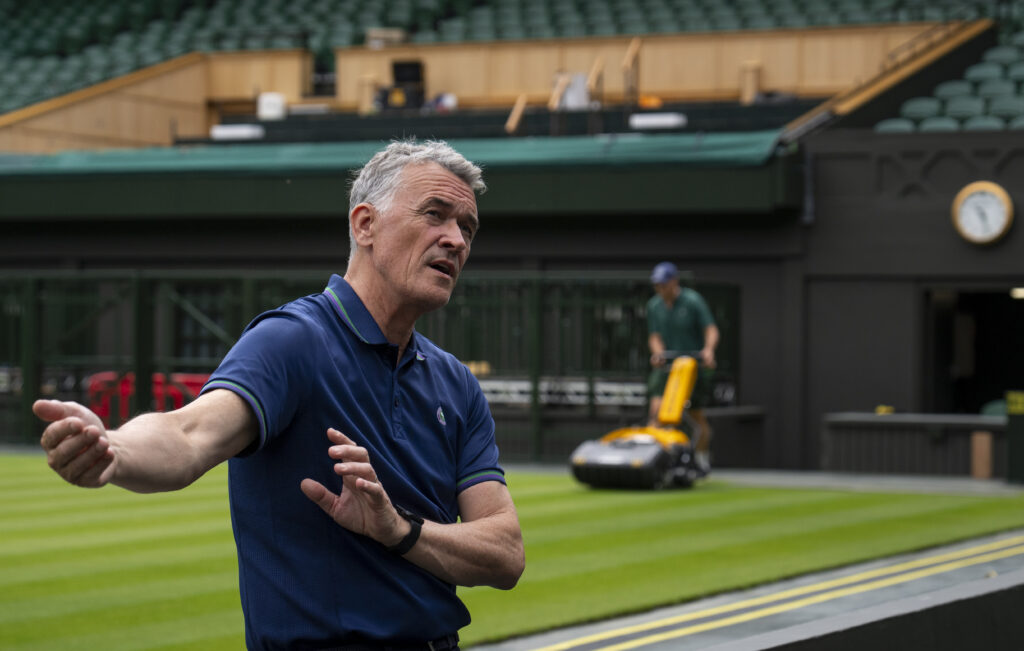
Ahead of the tournament beginning, Neil was kind enough to take time out of his busy schedule to talk me through how he gears up for the tournament, how his job has changed throughout his tenure, what a typical day during the tournament looks like, his favourite parts of the job, and why consistency across all of the courts is crucial.
One of the most respected figures in the industry, Neil Stubley has been in his position of Head of Courts and Horticulture at Wimbledon for ten years, after being promoted from the position of Head Groundsman. As well as his role at the AELTC (All England Lawn Tennis & Croquet Club), Neil serves as Vice Chair of the GMA, helping drive standards across the industry and supporting its members.
Wimbledon has a reputation for having the highest standards in sport, where every blade of grass, every court line and every detail of the landscape is meticulously prepared to ensure perfection. Fans love it for the world-class sport, of course, but the environment is just as important in making Wimbledon what it is – truly unique.
Big responsibility, big pressure
2026 is set to be Neil’s 31st Wimbledon, but the responsibility is not lost on him: “There’s always pressure. People camp out for days before the Championships even starts just because they love Wimbledon so much. It’s a big responsibility.”
To put some kind of perspective into what it takes to prepare these courts – let’s have a quick look at some numbers. Neil and his team maintain 18 courts, as well as 20 practice courts. They must be robust, as over 1,000 hours of tennis will be played on the courts over the two weeks of the Championships. This is why there are constant checks of the surfaces – the hardness of the courts will be checked over 18,000 times, and the baseline will be measured for wear over 31,000 times. Even something as precise as the correct ball bounce height will be checked 1,822 times!
The courts are a living thing – they grow every day and must be maintained accordingly, especially during the tournament. The surfaces must be on the tipping point of being under stress to provide the best playing surface – it is a constant balance between providing the best aesthetics and the best playing surface.
Neil believes investment in the playing surface, in any arena, is one of the most important factors to producing good sport.
“You see these Premier League clubs who spend hundreds of millions of pounds on a player, but if they don’t have the surface to match it, they won’t be able to perform. Suddenly, they’ve wasted all their money.”
Weather-wise, what would be a perfect day?
Of course, producing top quality courts is not always easy, as a big part of the preparation for a Championships is dictated by the weather.
“I have an incredible amount of weather apps. Probably more weather apps than you could even imagine!” says Neil. “But the one we use nowadays is METEO France, which also provides forecasts for Formula One. In terms of an ideal day once the tournament begins, probably one where it’s sunny and around 24/25 degrees. When it’s damp and wet – that’s the challenge.”
Indeed, if it’s raining during the Championships this year, give a thought to the grounds staff. If the courts get wet, grass grows quicker, there’s a higher chance of disease, and it’s harder to do any maintenance to wet grass (rolling, mowing etc).
What does the annual maintenance calendar look like?
After the hottest summer on record in 2025, and a very hot Wimbledon, Neil and his team would have immediately checked the courts for wear, stripping away damaged grass as renovation and reseeding began.
In the autumn, September and October are the critical months – decisions that are taken here will largely determine the quality of the courts the following summer. After the extremely hot summer, September turned notably wetter, which will have provided favourable conditions for growth ahead of the fall in temperatures in the wintertime.
During the winter months, there is little visible growth. It is a case of preserving the courts’ health, with nutritional programmes and maintenance schedules refined. Grow lights are incorporated, providing the grass with some much-needed support through winter. The chance of disease is also reduced during this period due to the use of fans, helping dry the surfaces.
Once spring arrives, growth accelerates and mowing becomes more frequent. But this is a time for tweaking the surfaces, rather than developing them.
By the time the first game on Centre Court takes place, players have already been using (and wearing) the surface for a week during practice week, albeit not quite at full match intensity. However, after extensive research over many years, courts now have grasses which are much more tolerant to wear and dry conditions – they are composed of 100% rye grass, and have been since 2001. The exercise of steam sterilising has improved control of weed grasses (Poa), helping to achieve a near pure sward of desirable grasses that can withstand the demands of Wimbledon.
Throughout the year, fertiliser will be used, with advances in technology enabling more precise nutritional management of the courts. Each court has its own irrigation programme, enabling targeted, accurate watering and making it less reliant on the UK’s unpredictable weather.
Daily Schedule
Neil’s daily schedule on a tournament day sounds, as you’d imagine, pretty hectic. His alarm will go off at 5am, when he’ll get up, get out, and walk the dog. It’s during this time that he gets a small piece of calm and quiet, which is necessary so he can plan everything he is going to be doing that day.
After that, it’s off to the courts, where the covers come off at 7:30am. Neil will walk all 18 courts, inspecting them for wear and any damage, hazards, presentation, consistency through courts and any other changes from the day before.
For example, a player getting angry over a decision and smashing their racket could damage the playing surface – part of the reason why they are fined so heavily.
After completing the walkaround, and addressing any issues before play starts on the outside courts at 11am, Neil will base himself in Centre Court or No.1 Court, where you might think it is time to relax and watch some world-class tennis? Nope – this is when the anxiety really begins.
Players tripping or slipping are always nervy moments for the grounds staff, as questions may be asked of the surfaces. Play will then go on throughout the day, with the worst-case scenario being play finishing at 11pm, as this limits prep time for the next day, at which point, it’s time to do it all over again.
The challenges and benefits of preparation in the modern day
Whilst perfection is always strived for at Wimbledon, factors such as the weather do not always make it possible – although Neil and his team do a fine job in trying to navigate such challenges.
With summers getting hotter and droughts becoming more frequent, water restrictions are increasingly becoming a factor. For sports facilities, these restrictions do not apply, but the club still tries to limit water usage with targeted irrigation.
Additionally, stricter legislation on pesticide usage has changed the landscape. Around sixty years ago, mechanical and cultural techniques were primarily used to control weeds and disease. Then, in the 1960s, chemical pesticides were widely used. Now, in many cases, it’s effectively come full circle, with far fewer products available and an emphasis on natural techniques due to regulation.
Work is constantly ongoing to improve the grounds and the processes behind it, such as soil biology. Research carried out around ten years ago has led to methods which were incorporated in 2017, particularly about how quickly bacteria regrows and how plant life recovers as a result. With 200 tonnes of soil used each year to level the courts, research like this has a significant impact.
All of this feeds into the number 1 target, which is to produce surfaces which are consistent from court to court, with uniform pace and bounce. Players may be on an outside court one day and Centre Court the next. As a result, the quality of the surfaces must be identical.
Courts are prepared in a similar way each year, with independent verification from the STRI (Sports Turf Research Institute). Each day throughout the tournament and a week before the tournament begins, the STRI takes daily measurements, including the hardness of the surface, the cover of live grass, a Chlorophyll index, the ball rebound percentage, the soil moisture content, and cracking. All of this data is made available to the grounds staff, which helps them shape decisions.
Best part of the job?
I asked Neil what the best part of his job was, and he spoke about a number of factors. Firstly, as explained earlier, he said that it was an honour to have the responsibility of looking after one of the most iconic global sporting venues.
Because of his position, Neil is also able to attend many other sporting events. “I’m lucky enough to be able to shadow counterparts at other venues, such as Augusta, Lord’s and Wembley. We also collaborate with the other Grand Slams (Roland Garros, US Open & Australian Open) to see what each of the others are doing and seeing what we can learn. Of course we are the only one with grass courts, but there are still certain things that overlap.”
What about during the tournament – obviously there is a lot of work to do, and lots of pressure – but is Neil able to actually enjoy it?
“It’s like what referees say in football in a way. If we get to the end of a tournament, and the courts are not mentioned – then good, we’ve done our job. The big thing for us is, at the end of the tournament, can we look ourselves in the mirror and say ‘we did the best we can?’”
GMA NextGen
“There’s a saying in the industry that when you work in grounds care, you age in dog years – so that would make me 152!”
“It’s a struggling industry with an ageing workforce, with around 90% experienced staff and around 10% apprentices. Many don’t know the industry actually exists, which is why we hold open days for younger people.”
Also helping to address that challenge is the GMA’s NextGen initiative, which aims to inspire and nurture the next generation of grounds professionals. We met with one of the GMA NextGen members, Ollie Mahon, who has been supporting Wimbledon ahead of the Championships. “I’ve really learned a lot being here – the level of detail has blown my mind.”
Furthermore, the GMA’s Schools into Stadia scheme provides a unique opportunity for local students to explore legendary sporting landscapes and see the meticulous craft of grounds care in person. By engaging in practical activities with insights from experienced voices from within the industry, young people are able to learn from the best in class about what it takes to produce a top-quality sports surface. Some of the iconic venues they’ve been to include Wimbledon, Lord’s, and Anfield.
View this post on Instagram
Not just a few weeks work
An important thing to consider the next time you’re watching Wimbledon: we see the perfectly manicured courts, the beautiful grounds that surround them, and have a certain expectation over what they might look like that we almost take for granted. Perhaps the biggest misconception is that all of this is only the product of a few weeks’ work each year.
The reality is that a lot of unseen work goes into the preparation of the courts and grounds.
Neil and his team work year-round to look after Wimbledon – every stage of the court’s development, from post-Championships renovation through to practice week the following year, is carefully managed and refined.
The work that Neil and his colleagues do never stops – there’s no sport without these guys.
Established in 1934, the Grounds Management Association (GMA) is the UK’s leading industry body for the sports turf and grounds care sector. A not-for-profit membership organisation, the GMA promotes and protects the interests of professional and volunteer grounds people.
For more stories like this, visit our news section.