
More UK local authorities recognise trees are not simply there to look pretty but present vital infrastructure.
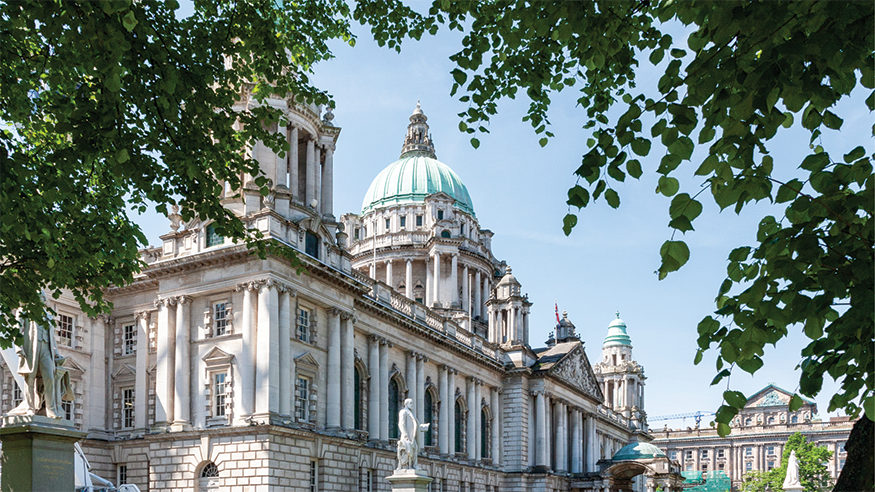
Here, Treeconomics, specialists in urban forestry. tree strategy development and the sustainable management of urban forests, outline the key elements of a successful scheme and discuss how Belfast City Council created one.
From climate resilience and biodiversity to public health and placemaking, urban trees can deliver benefits lasting decades. A comprehensive tree strategy provides the framework to manage this asset properly – but not all are created equal – serving only as a box-ticking exercise and achieving little other than wasting time.
The sector recognises that the greatest threat to urban trees is not only development but also the absence of long-term strategic management. As urban forestry expert Kenton Rogers MICFor| highlights, historic studies show most UK urban forests lack proactive management – progress in adopting comprehensive tree strategies has been slow over the last two decades.
Simply put, a tree strategy is a long-term plan for how trees across a town or city will be managed and developed. It sets out measurable targets for establishing new trees, caring for existing ones and explores how departments will collaborate to protect the urban forest, and how tree equity can be achieved for all residents.
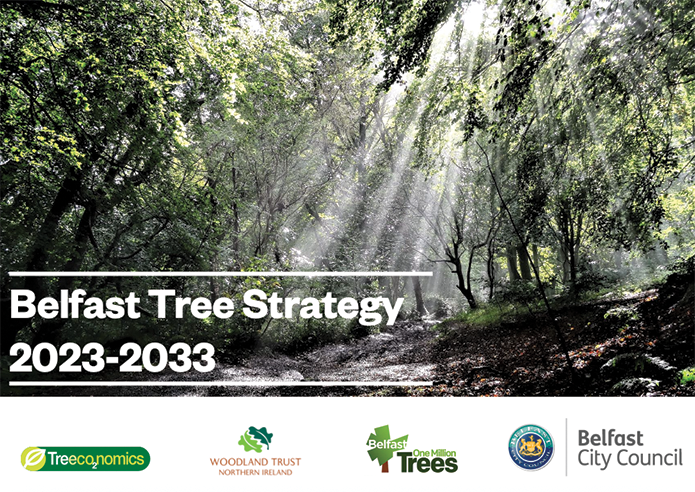
The Belfast City Council tree strategy provides an excellent example of what such a document could look like. Launched in 2023 (and part funded by The Woodland Trust), it provides a 10-year framework for protecting and and growing the city tree stock. It includes a detailed action plan for the first three years, structured around 37 targets, priorities and actions. These are explicitly linked to wider city objectives, including climate commitments, public health, regeneration and biodiversity. In this way, Belfast’s trees are central to decision-making rather than treated as peripheral.
A Successful Strategy
1. Focus on local people
Belfast’s vision is to be a city “which focuses on protecting, enhancing and expanding its woodlands. hedges and trees, connecting people to nature and ensuring these continue to be a major asset to everyone who lives in, works in and visits our city.”
Although city-wide, the vision is delivered at neighbourhood level to reflect the fact that trees are vitally to those who experience them every day.
Accordingly, Belfast’s strategy underwent extensive consultation, attracting more than 600 responses from the public. As Kenton Rogers observed: “Meaningful consultation often reveals strong public affection for local trees, which goes against the perception that trees are viewed primarily as a nuisance.”
2. Evidence first
A strategy must begin with an understanding of what already exists. Belfast carried out detailed assessments including an i-Tree Eco study, to establish current tree numbers, species diversity, tree canopy cover and condition.
The evidence revealed the current state of its urban forest and progress made over recent decades but also highlighted how far the city still had to go. Such data is an essential starting point for any successful tree strategy.
3. Clear, measurable goals
Belfast has used internationally recognised benchmarks (including tree canopy cover, tree equity analysis, and the 3-30-300 rule2), to set targets against which it can measure its progress over time.
According to Kenton Korers, defining what a city is trying to achieve – whether that be increased tree canopy cover, improved biodiversity, or better climate resilience – is essential before resources, policies and partnerships can be set up effectively.
4. Embrace tree equity
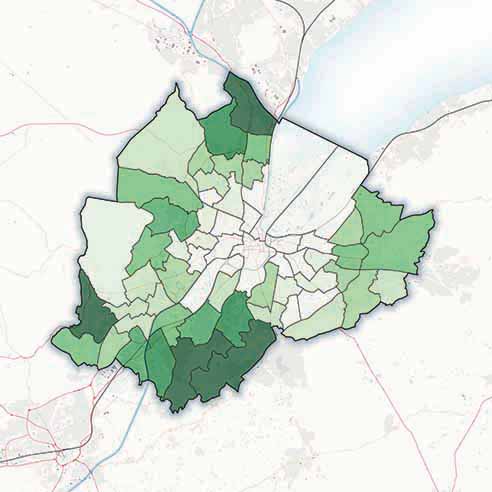
A strength of Belfast’s approach is its focus on tree equity. Mapping tree canopy cover alongside indices of multiple deprivation has helped identify neighbourhoods with greatest need for trees, to allow the council to plan tree planting and management in the most needy areas.
Growing recognition exists within urban forestry that equitable access to trees should be a core consideration. not an afterthought, given the links between canopy cover, health outcomes and social inequality (harking back to 1 in this list).
5. Prioritise long-term management and tree establishment
Tree planting alone will not deliver a resilient urban forest. Species selection, soil volume, aftercare and continuing maintenance all need considering. Trees must be planted in the right place, for the right reasons, and be managed properly if they are to survive to maturity.
Kenton Rogers consistently highlights that governance, funding and proper resourcing are as important as numbers planted. Without them, planting programmes often fail within a few years.
Under this five-point plan, a solid tree strategy can emerge that is people centric and aims to benefit future generations.
Specialist Support
Belfast’s tree strategy was developed collaboratively by the city council, local stakeholders and urban forestry specialists Treeconomics, which co-ordinated the project and provided the evidence base.
Such a partnership reflects a growing trend: as tree strategies become more data-driven, many authorities are drawing on specialist expertise to ensure decisions are backed by hard evidence such as tree canopy data and diversity reports.
Looking ahead
Belfast’s experience demonstrates that a successful tree strategy needs to be a living document, evolving as data improves, trees grow and city priorities shift.
For landscape professionals, it offers a reminder that trees thrive best when backed by a clear strategy and collaboration across multiple partners – principles consistently highlighted in Kenton Rogers’ work on sustainable urban forest management.
Alan McHaffie, senior woodland and recreation officer at Belfast City Council echoes this need for a clear focus: “As a direct result of an extensive public consultation exercise, where we listened to the voices of our communities, working alongside arboricultural experts and key stakeholders, the Belfast Tree Strategy has provided the council with a clear focus and direction as we continue to expand, protect and nurture the urban forest under our care.”
https://www.belfastcity.gov.uk/documents/belfast-tree-strategy
I Kenton Rogers MICFor is a chartered forester and director at Treeconomics, specialising in urban forestry, tree strategy development and the sustainable management of urban forests. He works with local authorities across the UK and Ireland to help embed trees into long-term planning, governance and decision-making.
2 The 3-30-300 rule proposes that residents should be able to see three trees from their home, live in a neighbourhood with at least 30% tree canopy cover and be within 300 m of quality green space.
3 https://uk.treeequityscore.org
4 Treeconomics is a UK-based enterprise, working to understand, value and improve urban forests. Using data science, GIS analysis, and collaborative research, it helps local authorities, land owners and communities make evidence-based decisions about the trees in their care. Treeconomics delivers canopy studies, i-Tree Eco projects and tree strategies across the UK.
https://treeconomics.co.uk/