
Diamond blades are often seen as specialist masonry tools but their versatility makes them a great option for a range of landscaping jobs, argues Darren Binns, Jefferson Tools national sales manager, who explains what to look for when choosing the right blade for the job.

Spring is when landscaping moves from planning to production. You might need to trim natural stone paving, finish porcelain slabs or shape concrete edging. It’s easy to reach for whatever blade is already in the van but not every cutting tool is designed to cope with a whole host of materials.
Diamond cutting blades are often linked purely with masonry and concrete but they offer far wider capability than that. For professionals looking to improve cutting speed, finish quality and blade longevity across multiple jobs, diamond technology is a serious option worth considering.
These circular blades use industrial-grade diamonds on the cutting edge and unlike traditional toothed blades that slice through material, they grind. As the blade rotates, exposed diamond particles grind the surface and as the edge gradually wears away during use, fresh diamonds are revealed to maintain performance.

Versatile option
It’s this grinding action that gives diamond blades their versatility. They are highly effective on concrete, asphalt, brick, granite, slate and other natural stone and ceramic.
They can even be used on rigid steel conduit and certain timber or composite products, making them useful beyond purely stone-based landscaping tasks. For landscapers juggling patios, pathways, retaining walls and driveway preparation, that flexibility can reduce the need to constantly swap tools.
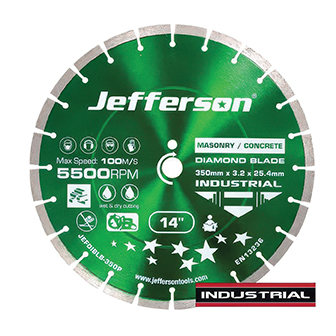
Not all diamond blades are created equal or have the same lifespan however, and segment height is one of the main reasons why. Higher-quality blades tend to have taller segments, often around 10 mm on 4½ in and 9 in blades and 12 mm on 12 in and 14 in sizes.
Some lower-cost alternatives use shorter segments, typically between 5 mm and 10 mm on comparable diameters. While those blades may come at a lower initial price, taller segments provide more usable cutting depth, so the blade lasts longer before it needs replacing – a benefit that can make a real difference during a busy season.
Less downtime
Diamond concentration within the segment also matters. A higher density improves cutting consistency and helps the blade cope with abrasive materials such as asphalt or dense concrete. When laying multiple driveways or trimming heavy paving throughout spring, these design details translate directly into productivity and reduced downtime.
Choosing the right blade configuration is important too. Segmented blades are good for dry cutting concrete, asphalt and general masonry. The gaps between segments allow for air to flow and debris to clear so they’re well suited to outdoor groundwork where water may not be practical.
Continuous rim blades on the other hand, are ideal for wet cutting porcelain and decorative tiles.
The uninterrupted cutting edge reduces chipping and produces a cleaner finish, essential for visible patio installations. For more demanding applications such as reinforced concrete or clay pipes, laser-welded blades provide additional strength and segment security, particularly at higher operating speeds.
Match speed and specification
Diameter should match both the material and the machine. Smaller 115 mm blades are useful for detailed trimming and confined spaces. A 230 mm blade is often the workhorse for general slab cutting while 300 mm and 350 mm blades are better suited to deeper cuts in concrete or thicker sections during driveway preparation. Checking bore size compatibility and ensuring the blade’s maximum operating speed matches the saw specification is essential.
As with any cutting equipment, technique plays a big role in ensuring clean, precise cuts. Diamond blades are designed to grind through material under controlled pressure. Forcing the cut generates excess heat and accelerates wear so the blade should enter the material smoothly and keep a steady feed pressure to maximise service life.
Where possible, wet cutting cools the blade and suppresses dust, extending performance and improving site safety. In dry conditions, appropriate dust extraction should always be used.
As the pace picks up in spring, most landscapers just want tools that get on with the job. When you’re switching between slabs, kerbs, edging and drive prep, stopping to swap out worn blades or fight through a cut slows everything down.
Choosing the right diamond blade with the right segment height, build quality and configuration will help you work efficiently and get a clean finish first time. If your current blades struggle with mixed materials or don’t last as long as they should, it might be worth taking a closer look at what you’re using.