
The Landscaper was out and about again last month, this time at Pall Mall’s Royal Society of London for the BALI (British Association of Landscape Industries) National Landscape Conference.
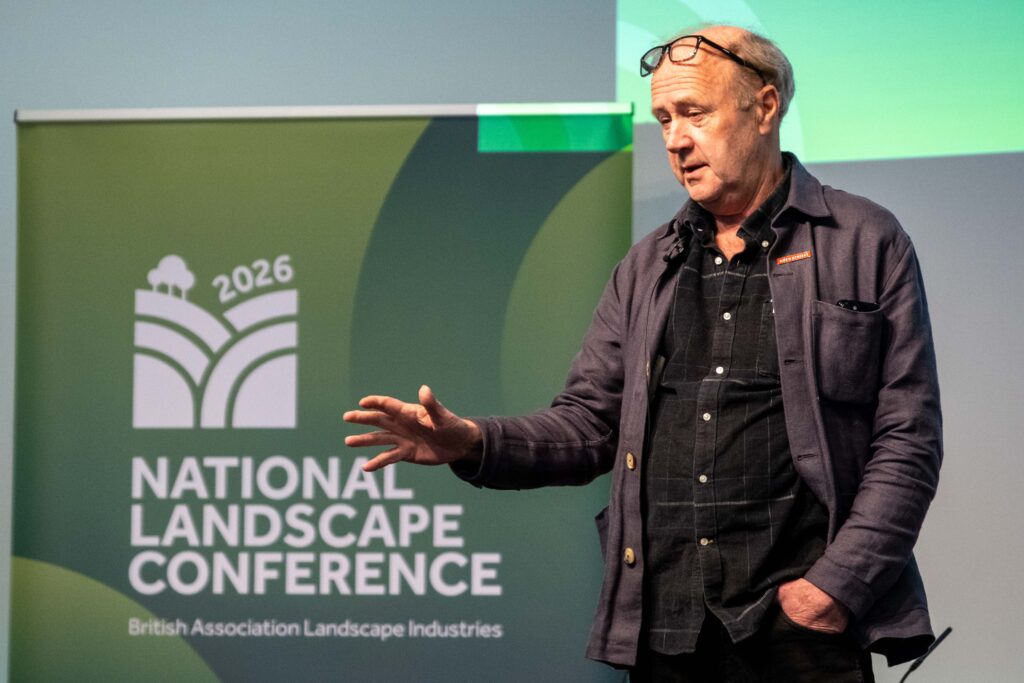
© Julian Dodd, HortWeek
We arrived early, keen to catch up with some familiar faces from across the BALI community and to start making new connections in the fabulous surroundings of the Royal Society of London. After a quick coffee, we made our way into the lecture hall, where we were welcomed by BALI Chair Adrian Wickham, who gave an introduction to what the day would entail. Adrian explained that, despite all of the difficulties the industry is currently facing, coming together like this is more important than ever.
The day was split into two main sections, with three keynote speakers delivering talks in the morning, followed by a number of breakout sessions taking place in the afternoon.
The Keynote Speakers
The first to speak was Trevor Williams, a former Chief Economist at Lloyds Bank Commercial Banking, now a respected economic commentator, academic, and consultant specialising in global, data-driven economic analysis. Trevor shared insights about the global trends and economic forces impacting landscaping, such as population growth, climate change and technological development.
Of all the countries in the G20, the UK is set to face the biggest hit to growth from the Iran war. GDP growth is forecast at only 0.7%, while inflation is predicted to be 4%. Interest rates are expected to remain at 3.75% at best.
These economic factors are challenges that are shared by all firms, of course, but Trevor speculated on what this could mean for the landscaping industry. Ultimately, costs will rise, demand will fall and the gap between revenue and costs will deteriorate.
However, Trevor emphasised that, as human beings, we need green spaces. There remains a strong lifestyle demand for outdoor living. Furthermore, property is often seen as a way to protect value during times of economic uncertainty. Regulation is driving biodiversity and water management, while urbanisation and the growing need for climate-resilient spaces gives the industry hope for growth.
Technology and innovation are providing hope for growth too, with automation easing labour pressures, increasing productivity and reducing operating costs. There are opportunities in the next decade: many of the current challenges to the landscaping industry may bring a lack of growth in some areas, but as the sector evolves, others will emerge.
“I look forward to seeing you all in Heaven”
Sir Tim Smit KBE was next to take the stage, co-founder of the multi-award-winning Eden Project in Cornwall and a driving force behind the revival of ‘The Lost Gardens of Heligan’.
Sir Tim inspired the audience with his passion for regeneration, speaking about the need for more beautiful environments and how being in nature is so important, as it’s linked to mental wellbeing and happiness.
Tim spoke about the importance of attending, noting that the people working in this industry – the people in the room – really can make a positive difference in both the sector and the wider community, by embracing science, romance and vision. His parting words, ‘‘I look forward to seeing you all in heaven,’ reinforced how much love he has for the industry and the people within it.
In a week when Sir Tim was celebrating the 25-year anniversary of the Eden Project with a visit from the Royal Family, he made time to come down to London specifically for the BALI conference, further demonstrating the significance he places on the landscaping industry.
This writer once visited the Eden Project and urges everyone reading this to do the same.
Biodiversity Net Gain (BNG) & Climate Resilience
The Director of Ecology at Verna, Helen Nyul, has over 20 years’ experience working on business and biodiversity strategies at the intersection of development and policy. She highlighted key lessons from her career, illustrating practical approaches and real-world outcomes.
BNG is a mandatory approach to development and land management, that requires nature to be left in a measurably better state than before a project. It has become mandatory for major developments since February 2024 and for small developments since April of the same year.
Helen explained how BNG could shift from a regulatory compliance exercise to become a strategic tool for resilient planning and landscape design – if adopted effectively. She emphasised the importance of early engagement by all stakeholders, including designers, contractors, planners or clients – anyone along the chain has a voice and can support biodiversity efforts.
Helen brought the UK’s green skills shortages into sharp focus, with a projected gap of around 200,000 – 400,000 workers needed in the coming years to meet net-zero targets. For context, demand for green skills surged 46% in 2024, yet the workforce only increased by just 5.3%. This gap is particularly alarming as the industry transitions from amenity maintenance to biodiversity-focused habitat implementation.
Helen’s enduring message was that landscaping businesses should be running their business for the climate we have now, not the environment we had, integrating forward-thinking, modern approaches.
Breakout Sessions
After lunch, there were a number of breakout sessions taking place simultaneously. We decided to attend the ‘Workplace for the Future’ session, which was hosted by performance mindset coach Sam Grayson. Many important topics were covered and discussed by the panel, which included Paul Downes, Gamiel Yafae MBE, Anna McLoughlin and Andrew Fitzmaurice, such as leadership, high performance and ideas on how to introduce more younger people into the industry.
Following that, there was the opportunity to attend one final breakout session which was again hosted by Adrian Wickham, with Mark Powell, Kim Sones and Luke Mayberry exploring the economic landscape. With all members currently working for banks and accountancy companies, the panel were very well placed to discuss the impact of the Iran war on the economy, and what it may mean for UK businesses, particularly in the landscaping sector.
Navigating Change and Leading it
This was the Association’s first conference in almost twenty years, taking place at a critical time. Climate pressures, supply chain disruptions and the economic and political landscape make this a challenging time for the British landscaping industry.
The National Conference was designed to challenge the thinking and strengthen the network of all those within the community, and, most importantly, provide some optimism about what BALI members can achieve when they work together.
The present is certainly challenging, but the future is bright with opportunity.