
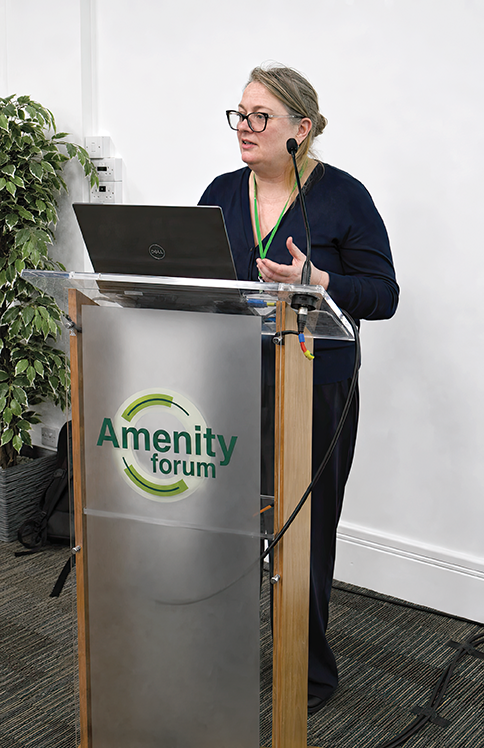
The right intervention, in the right place at the right time is the goal, explains Corrina Urquhart, new executive officer of the Amenity Forum.
The policy landscape for vegetation management is changing. Over the coming months, the conclusion of Great Britain’s glyphosate renewal review – the Government’s review of the Code of Practice for Using Plant Protection Products – and the wider implications of the UK’s evolving relationship with the European Union through the EU Reset will all influence the environment in which our sector operates.
The glyphosate renewal review, led by the Health and Safety Executive (HSE) on behalf of ministers, is expected to conclude later this year following a public consultation.
It represents one of the most significant regulatory reviews affecting vegetation management in recent years, with implications for everyone responsible for managing parks, highways, sports facilities, housing, utilities and the wider public realm.
Shaping Standards
Alongside this, the Government is reviewing the Code of Practice for Using Plant Protection Products.
While it may attract fewer headlines than glyphosate, the revised Code will play an equally important role in shaping day-to-day professional practice to ensure guidance reflects changes in legislation, technology, environmental expectations and modern approaches to vegetation management.
Set against this, the Government’s wider EU Reset provides an important strategic backdrop. Although Great Britain now operates its own regulatory regime for plant protection products, closer co-operation with the European Union may influence the wider policy environment in which decisions are made.
Together, these developments present an important opportunity, not simply to respond to change but to ensure policy is informed by robust evidence, professional expertise and practical experience rather than polarised opinion.
I joined the Amenity Forum earlier this year as executive officer after almost two decades working across the land-based sector in policy, professional development and education, including executive leadership roles at Lantra and BASIS Registration Ltd.
Throughout my career, I have worked at the point where evidence, policy and practice intersect. Time and again I have seen that the most effective solutions emerge when organisations work together around shared objectives rather than retreating into opposing positions. That philosophy underpins the Amenity Forum.

Independent role
Since its formation in 2003, the Forum has brought together professional bodies, regulators, industry organisations, awarding organisations, training providers, contractors and commercial partners to promote the safe, effective and responsible management of vegetation. In a sector as diverse as ours, that independent convening role has never been more important.
Our ambition is not simply to respond to consultations or react to policy change but to champion professionalism, encourage collaboration across the sector, support evidence-informed decision-making and share best practice in vegetation management. We want to help connect policymakers with practitioners to ensure decisions are informed by both robust science and operational experience.
Just as importantly, we want to communicate the value of professional vegetation management more effectively to policymakers, the media and the wider public.
Those working in landscape management make decisions every day that balance biodiversity, environmental protection, operational practicality, public expectations, financial pressures and public safety.
There are rarely straightforward answers. Every site presents different challenges and every decision requires informed professional judgement. Yet too often, that complexity is lost in public debate.
Integrated Pest Management (IPM) provides perhaps the clearest example of why professional judgement matters.
Structured framework
IPM is sometimes portrayed simply as reducing pesticide use or replacing one technique with another. In reality, it is a structured framework for decision-making that encourages practitioners to consider the full range of available options before selecting the most appropriate approach. Prevention, monitoring, cultural, mechanical and biological controls and, where necessary, the responsible use of plant protection products all have an important role to play.
As our chair Ian Graham has emphasised, the objective is not to champion one solution over another but to apply the right intervention, in the right place, at the right time. That balanced, evidence-led philosophy underpins the Amenity Forum’s position and reflects the realities faced by those responsible for managing parks, highways, sports facilities, housing estates and the wider public realm.
The ongoing discussion surrounding glyphosate demonstrates exactly why this approach matters. Public debate can quickly become polarised, yet practitioners understand that every location presents different risks, constraints and environmental objectives. Decisions should therefore be informed by robust scientific evidence, practical experience and proportionate risk assessment rather than simplistic narratives. There is rarely a one-size-fits-all answer.